AIRSPACE · INTERNAL PLATFORM
Scaling pricing to charge for diverse requirements
At Airspace, I led design efforts to scale our pricing system, enabling it to be adaptable and flexible to charge for unique customer needs and business service offerings. This approach led to more accurate upfront quotes and invoicing for customers, which improved internal operational and financial efficiency.
Impact
In one instance of applying the new pricing system, the accuracy of charging for a specific service increased, resulting in a 23% overall reduction of unintended charges.
Core Team
3 Designers, 1 UX Strategist, 1 Design Manager, 3 Developers, 1 Product Manager
Role
End-to-end Product Designer
Duration
~4.5 months (spread throughout 2021 Q2 and 2022 Q1)
Note: Certain details are left out and images are intentionally blurry / cannot be viewed in higher resolution to adhere to an NDA. To learn more about this project, please contact me directly.
Overview
The Context
What is Airspace?
Airspace is a time-critical logistics company that specializes in shipping goods across various industries like aerospace and hospital/health systems.
For each order, customers are provided an instant quote based on parameters like the package weight. This quote is based on pre-agreed rates, which are configured on each customer's account by Airspace's finance team.
Initial Business Problem
While the initial request focused on pricing for European expansion, preliminary research shifted the objective toward scalability
product designer and I had conducted the following activities to gain more context on what "European pricing" meant for the product:
We concluded that our system needed to handle more than just "European rates," as there were already plans to expand our business beyond Europe. While unclear what exactly that pricing model looked like, we reframed our project to look at the underlying problem of system scale for global expansion.
Refined Business Problem
Airspace's global expansion and complex, unique shipping requirements increasingly exposed our pricing system's limitations
The volume of incoming requests to integrate new rate updates into upfront quotes exceeded R&D's capacity to implement them.
This created several ripple effects:
Financial and operational efficiency declined
Customers experienced reduced transparency and decreased trust
These inefficiencies ultimately hindered our revenue growth and profit margin.
The Challenge
How might our pricing system accommodate an assortment of customer and business requirements?
Vision Setting
Defining the Vision
The challenge of addressing new requirements extended across multiple departments
When Airspace introduced new services like global shipments, we would often build one-off solutions to address complex needs. However, this approach led to inefficiencies across the company, creating hurdles for internal teams and a disjointed experience for customers.
As a result, the project then evolved even further to be part of an overarching product strategy to address broader challenges affecting Airspace's internal teams, customers, and product.
Brainstorm
Design facilitated cross-functional brainstorm sessions to define six ideas to support business
These ideas were centered around the theme of scalability and self-service, as we wanted to create a system that could empower our internal teams to quickly support new services, without R&D involvement.
For the bulk of this case study, I will focus on two areas that I owned:

Services
- Internal users could define "services," or units of work which were triggered by order form inputs or data (such as a "print docs" service to request drivers to print docs for an order)
- Services could be tagged (i.e., an "order level service" or a "piece level service") to dictate how/when it could be used
- When requested, services would have any applicable charges calculated in the order quote

Customizable Rate Sheets/Charges
- Internal Airspace users could create new charges for a service on a company's set of rates to determine how exactly to charge for it
- When creating a new charge, users could define how to charge by configuring its "charge type" (such as "charge X dollars per package lb") and when to charge through "constraints" (such as "charge only if the package is over X lbs")
Paper Prototyping
My team used a low-cost approach to assess how participants interpreted this new system to validate our solutions
Using paper cutouts to represent the concepts, their sub-components, inputs, and actions, participants would interact with the "system", while we simulated its reactions, enforcing rules, providing context, and adding more cutouts where appropriate.
Overall, users understood the general concepts; the only considerable change was renaming "constraints" to "conditions." Given the scale of work involved, the different concepts were distributed into different projects across product teams.
Design Process
Scoping the Project
To deliver immediate value, I worked to scope my team's project to remove dependencies on the other concepts being built
From aligning with my product team, we determined that the various service and charge configurations would still require significant development. Additionally, other product teams that would develop the other features were not yet ready to start designing and developing.
Instead, we decided to model one service to use to build the new features. Over time, we could iterate and expand by adding in more configuration options and retrofitting existing rates, providing us with a clear, future roadmap.
Additional Research
The “Dangerous Goods” service was used as the first model, as there was more nuance to its pricing than the system currently could handle
Through support tickets, documentation, 3 interviews, and 2 shadowing sessions, I discovered that the finance team reactively zeroed out dangerous goods rates only after customer complaints. While the system charged solely based on a "Yes" banner response during order entry, the business desired to also apply the corresponding charge based on the specific type of shipped item (such as an aircraft part or tire).
Since the logic to charge was straightforward to be widely applicable and was independent of other features, I pitched to use dangerous goods to model for launching the new pricing system.
Feature Prioritization
I worked with my team to cut scope on ideas from initial brainstorming, but tested as dead weight
For example, we concluded that having different "types" of service ultimately did not have any clear user and business value, so we scoped out developing several of those options.
User Flows
I mapped 6 user flows across multiple user groups, which led to a reassessment of the prioritized features
Upon assessing the flows with my team, the strategist, and design manager, we realized:
I then re-prioritized what features would be built, shelving the ambiguous ones as opportunities for future iterations.
Usability Testing
Two different concepts for customizable rates were tested across 7 users to determine a preferred solution
After narrowing down two concepts to test from four different variations (two were dropped due to technical constraints and usability concerns), I observed any user misclicks and discussed their preference to get a direction of which UI to implement.
Testing results indicated a stronger preference for the second variation, as users indicated they preferred being able to access all the editable properties at once.
Refining Customizable Charges
Text length had to be factored into the UI, so the design went through another round of ideation
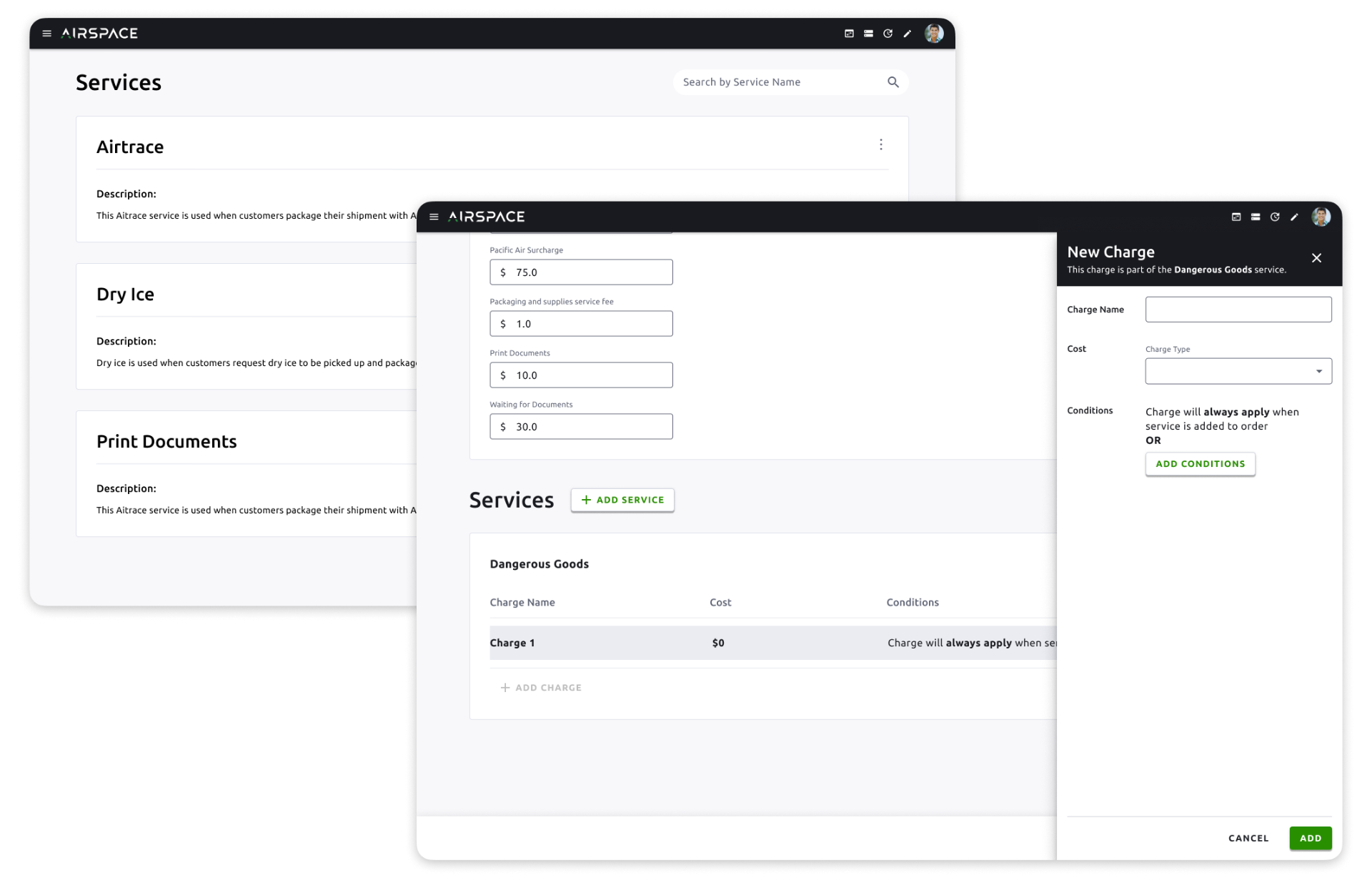
More display space was needed to accommodate conditions that could eventually be long text statements. From ideating solutions with the design team, I finalized a design that stored the form to create/edit charges in a side panel.
Conclusion
Final Designs
What shipped: A services library and configurable charge builder
Services Library
Internal users could create services to define customer or business needs. Services could also be used in other system concepts:
Customizable Rate Sheets/Charges
The finance team could add services onto rate sheets, which also segmented any unique services and its pricing to a given customer's rate sheet.
Charges could be configured for a service. How it was charged was defined by the charge type chosen to mirror how Airspace applied different charges (as a flat amount or per piece weight).
Conditions would encompass a variety of order data over time, so that the finance team could be exact in how to charge for a service. In addition, surfacing this logic in the UI would remove any confusion around the logic for a charge, which was a common user challenge I had found early on through interviewing users.
Results & Impact
Billing errors for dangerous goods were cut by 23% with zero manual financial intervention to adjust its charges
Post Release Challenges
Over time, the new pricing system was not adopted as expected due to a number of factors
As a result, additional iterations on Services and Rate Sheets were eventually deprioritized.
Reflection
Constant collaboration kept the work moving, but it couldn't guarantee the vision stayed connected across teams
While proactively raising risks and running alignment exercises created the impression of a shared vision across teams, the true challenge emerged during the actual build phase. New constraints and shifting priorities later altered how we could execute that vision. In hindsight, rather than assuming early buy-in would hold through implementation, I would design the initial system to better accommodate a partial rollout from the start.
Next Steps
The spirit of scalability and flexibility was carried onto another project
The adoption gaps directly shaped a follow-up project to simplify the system. The complexity that slowed adoption here, particularly around conditions and interdependent rollout, were factored into a later initiative (you can read about that project here).
Can't get enough of my work?
Well you're in luck—here's another project
you can read up on ➡️