AIRSPACE · INTERNAL PLATFORM
Rebuilding a pricing system to scale with the business
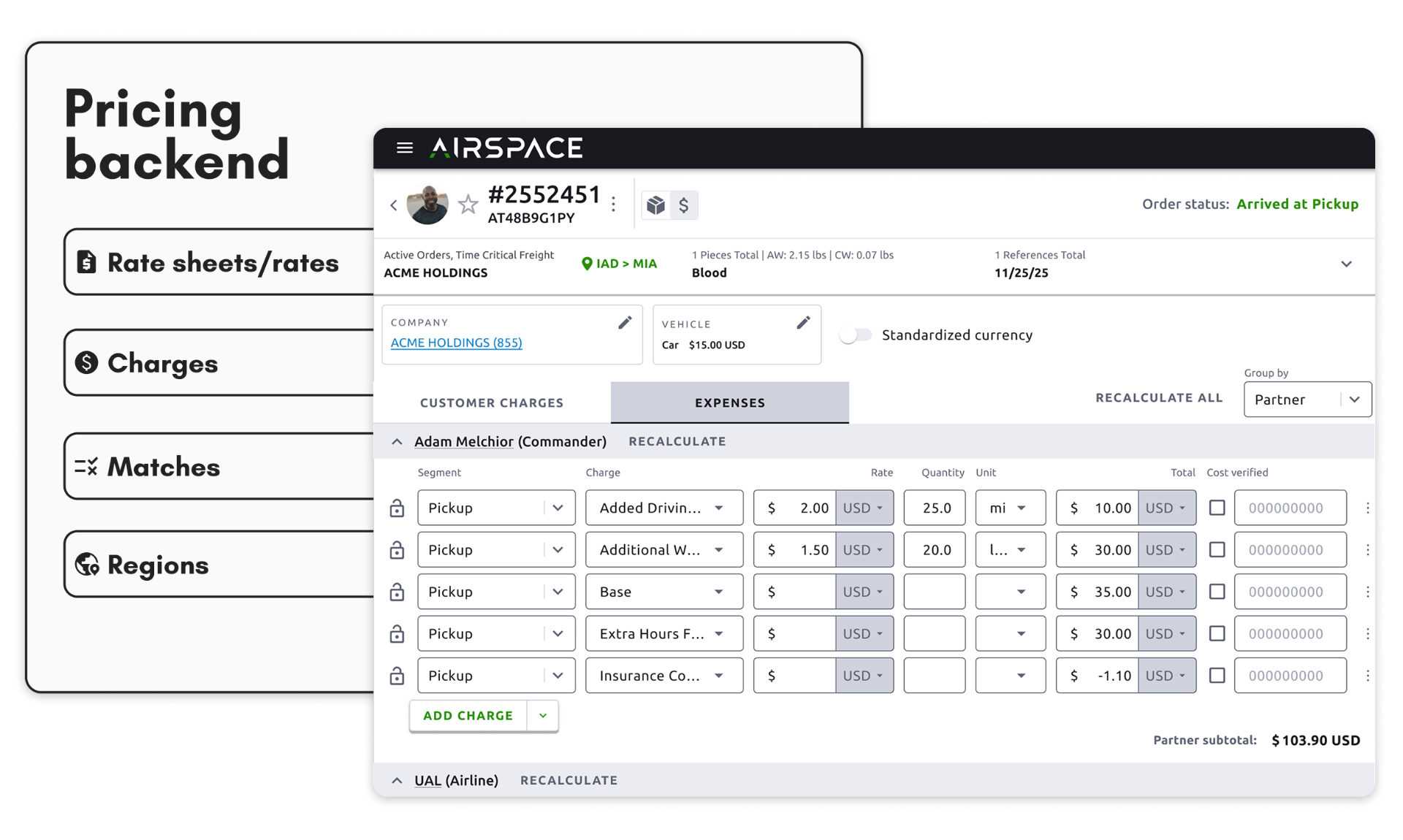
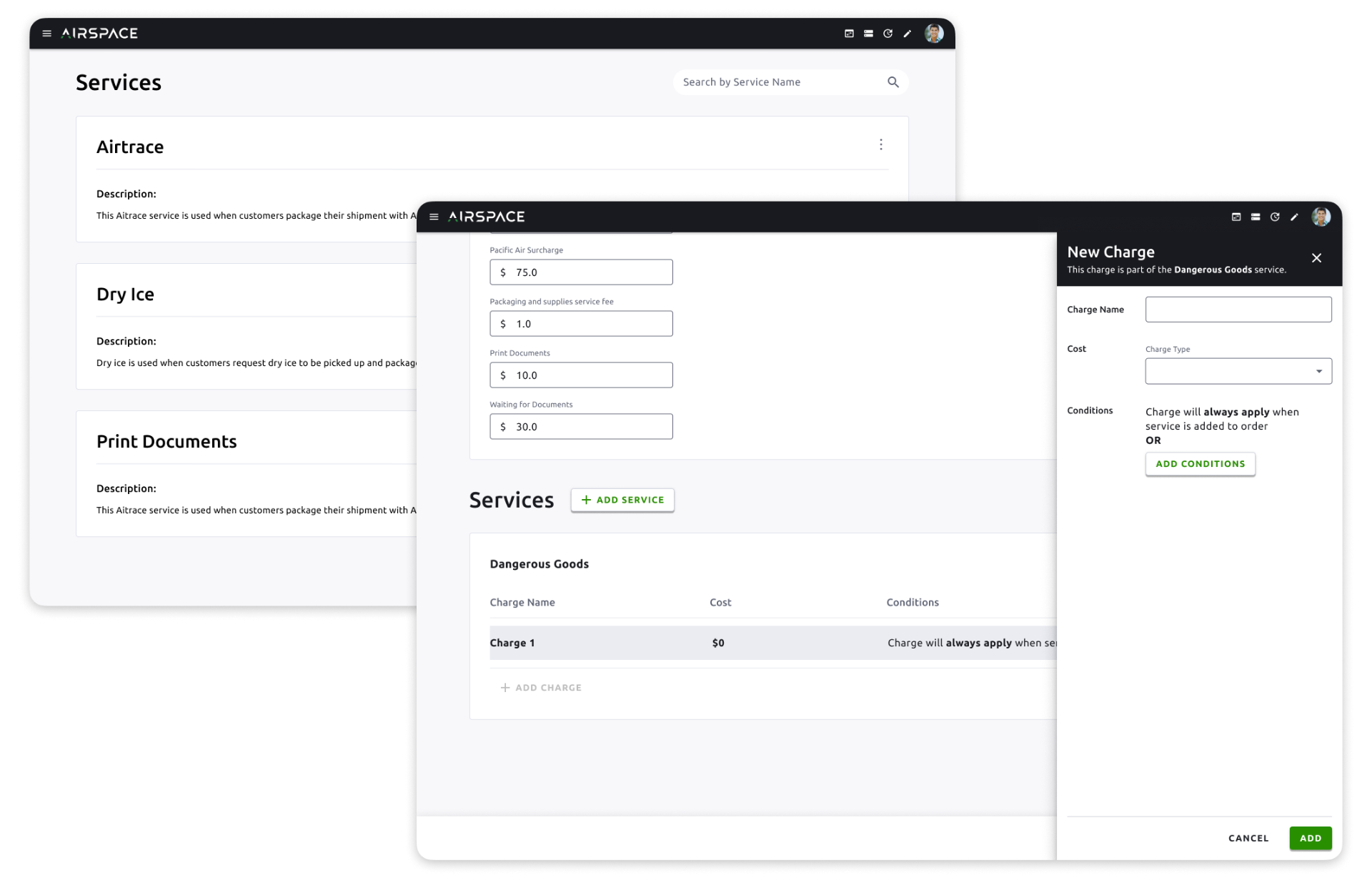
At Airspace, I was the lead designer and project manager for a full suite of pricing features to address business and user needs. My work spanned two work streams: Partnering with engineers to reshape the backend architecture, and leading the UI redesign of three core features.
Impact
In the two months following a targeted rollout, the new pricing system reduced post-order changes for third-party (drivers, airlines, etc.) costs by 30%. This improvement stemmed from enhanced accuracy in system-calculated costs and empowering different teams to manage pricing proactively.
Core Team
1 Designer (me), 5 Developers, 1 Product Manager
Role
Product Designer (lead) + Project Management
Duration
Backend strategy: June 2024 - Nov. 2025 UI redesign: Feb. 2025 - Nov. 2025
Note: The full process for the project are omitted due to an NDA. Please contact me directly if you want to learn more.
Project Brief
The Context
What is Airspace?
Airspace is a time-critical logistics company that specializes in shipping high-stakes items (such as surgical instruments, airplane parts, biological samples) for a variety of industries like aerospace and healthcare.
For each order placed by an Airspace customer, the internal operations team enlists third parties (such as drivers and airlines) to hep move the order from point A to B.
How Pricing Works
How pricing works at Airspace is simple in theory, but gets complex with sprawl
With hundreds of diverse pricing agreements and a wide variety of shipment types, pricing permutations end up varying greatly across all orders.
The Business Problem
The pricing backend couldn't keep up with business complexity
As pricing agreements became more complex, R&D couldn't keep pace to account for all the new requirements. This resource strain forced the business to rely on manual workarounds to accommodate growth.
These challenges manifested in different ways:
Costly invoicing errors
Constant revenue & expense adjustments
Added contractor spend
Delayed margin visibility
The Pivot Point
I advocated to think broadly on tackling the entire pricing ecosystem, as issues often overlapped across features
From an initial project brief to rebuild the pricing backend, it was already clear the work couldn't happen in a vacuum. Pricing features were interconnected with one another, and there had been accumulated user pains that stemmed from issues across those features.
I layered these in early scoping conversations, drawing pain points across related features to highlight the overlap and the need to think more holistically.
Merging the backend vision with these ecosystem-wide needs allowed our team to expand our scope from a simple fix to a comprehensive pricing ecosystem overhaul.
The Challenge
How might we redesign the pricing ecosystem to make it flexible, scalable, and honest to how the business operates?
Design Process
My Involvement
My contributions then spanned two work streams
- Collaborated with the head of pricing to understand their pricing strategy and how that could translate to system changes
- Led working sessions with developers to brainstorm and establish backend requirements from user stories across four backend features
- Pitched six changes across the four backend features, partnering with developers to implement the changes and iterate based on stakeholder feedback
- Partnered with stakeholders to discuss tradeoffs of implementing short term solutions to meet project timeline
- Audited 100+ real-world pricing scenarios against the new backend architecture to stress-test coverage and identify gaps
- Identified and pitched additions for five pivotal configurations to support common pricing scenarios
- Drove rollout coordination by issuing rollout plans, assessing cross-team impact, and creating two training guides across finance, analytics, driver ops, and rate administration ahead of release
Conclusion
Results & Impact
The pricing ecosystem scaled to handle business complexity
Can't get enough of my work?
Well you're in luck—here's another project
you can read up on ➡️