AIRSPACE · INTERNAL PLATFORM
Unlocking Aerospace Growth by Fixing Vendor Access
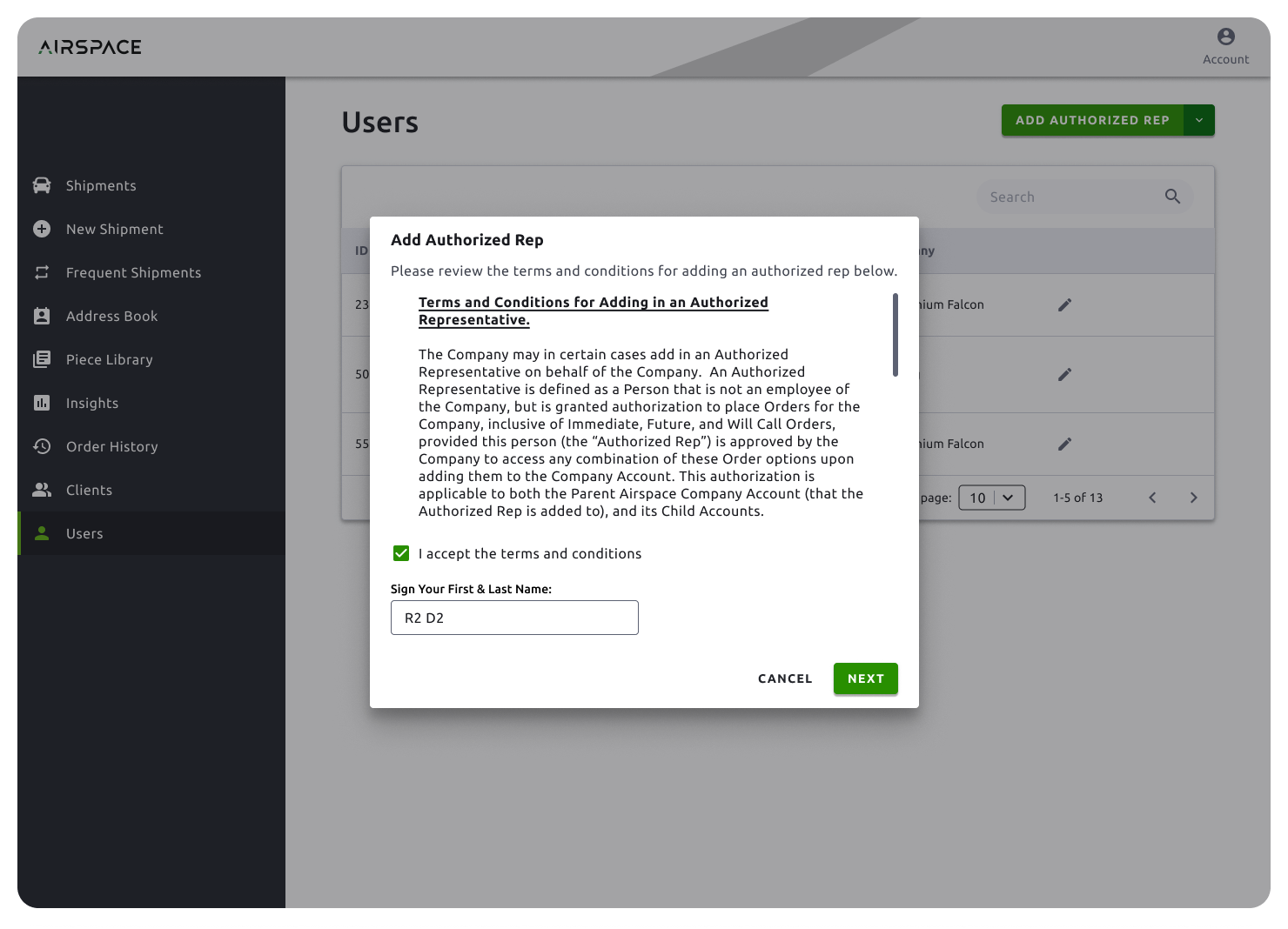
At Airspace, I designed multiple flows and screens to support a new user role for the customer platform. These updates enabled customers to add third-party vendors to access their accounts in a limited capacity and place orders on their behalf.
Impact
Streamlining account/user access for vendors led to 39 orders placed through this new role within a month of release.
Core Team
1 Designer (me), 1 Developer, 1 Product Manager
Role
End-to-end Product Designer
Duration
6 weeks | May 2023 – July 2023
Note: Certain details are left out and images are intentionally blurry/cannot be viewed in higher resolution to adhere to an NDA. To learn more about this project, please contact me directly.
Project Brief
The Context
What is Airspace?
At Airspace, customers are set up with their own, unique company account. Each team member from a company can then be added into the account via their individual emails. They can then place orders and access real-time updates for their shipments, based on their user role permissions.
Once an order is placed, Airspace uses AI-powered routing and dispatching to ensure timely delivery and provides constant updates for efficient, transparent delivery.
The Business Problem
Our platform restricted business with certain customers who had their own third-party vendors
In 2023, Airspace aimed to increase revenue in the aerospace sector from $2M MRR to $4M MRR by identifying opportunities to increase order volume. Product and account management discovered that customers from this sector often relied on third-party vendors to place orders, but they weren't always choosing Airspace to handle their shipments.
These vendors fit a combination or one of the following profiles:
Addressing these gaps would be crucial to meeting their needs and driving growth.
The Problem (Expanded)
Our login system limited each email address to a single company account
For example, spongebob@kp.com could only be added to "The Krabby Patty" company, but could not be added to "The Chum Bucket" company.
As a result, customers/our account managers tried to "hack" the system in the following ways:
Nesting vendor sub-accounts under each customer account
- Vendor team members would then need separate credentials for every customer they ordered for through Airspace, causing friction and lowering user traffic
- This exposed pricing/tracking data that customers didn't want their vendors to see
- With more accounts nested within their main account, this led to confusing experiences and complex account management for Airspace customers
Entirely separate accounts were created for the vendors to use
- The separate credentials issue also applied here for vendors
- Airspace's customer could not track the shipment their vendor placed within their own account, which broke the shipment transparency that Airspace promised
The Challenge
How might we simplify vendor account management while ensuring Airspace customers maintain control over sensitive information?
In addition, the product manager had set a 6-week timeline for this project (including both design and development work), so we would be working with this additional time constraint.
Design Process
Brainstorm & Ideation
I used an audit of existing user role system/permissions to drive discussions on a new solution
After assessing feasibility and scope of several solutions, we decided to introduce a new user "vendor order placer" role with tailored permissions.
Unlike existing roles, emails assigned to this new role could be under multiple company accounts and sub-accounts with the same role, or any other existing roles (in cases where an email already existed under their own company account). Thus, the 1:1 email-to-account restriction was no more.
Prioritization
My team scoped an MVP by prioritizing issues we gathered from our stakeholders and from auditing system capabilities
This clarified what I needed to design and allowed the developer to begin reworking the architecture.
Task and User Flows
Mapping out three different task flows and a user flow across different user groups helped uncover questions like: Who gets notified for new vendor actions, and when?
I brought these new findings to discuss with my team, in stakeholder feedback sessions, and/or evaluate through customer feedback.
Stakeholder Feedback
Internal testing surfaced gaps around legal terminology and new use cases
From testing two prototypes (one for adding/removing vendor users, another for navigating the customer platform as a vendor) with our account management team, I uncovered a few insights:
With the first two insights, I refined the prototypes and prepped questions for usability testing.
Prioritizing for the Future
Will call activation was a real need, but we could not fully scope it into the remaining project timeline
I had defined a task workflow to discuss implementation of will call activation. Given we could not fully address this request, my team instead made the following updates to support future iterations:
Usability Testing
Three rounds of customer testing led to more iterations on access limits and confirmed will call activation requirements
From testing, we learned a few new insights and verified the following:
The top two insights were out of scope for the project timeline. To wrap up the project, I worked with the developer to tweak tracking information access and finalize the designs for our MVP release.
Conclusion
Final Designs
What shipped: Three flows built to give customers control and vendors a clear, limited path to placing orders
New flow to add the “Order Placer” role
Centralized page to switch between company accounts
Revised order placement process for the "Order Placer" role
Results and Impact
39 orders were placed through vendor users across 4 company accounts in the first month of release
After working with development to put on the finishing touches for the new vendor feature, we released it at the end of July 2023.
Our sales team leveraged this feature as a differentiator to unlock aerospace deals, while our account management team simplified processes for vendors managing multiple Airspace customer accounts.
Reflection
Speed forced trade-offs, starting as early as with primary research
Pushing for more research earlier in the project
Working with a time constraint
Involving my team at every step of the way
Next Steps
Will call activation is still highly requested by vendors
Given this feature was deprioritized, I'd want to ensure support for will call activation for vendors was developed to expand opportunities for more order placement from our customers and our vendors.
Can't get enough of my work?
Well you're in luck—here's another project
you can read up on ➡️